The Start Up of You

by Reid Hoffman and Ben Casnocha

This is the book, I got so excited to read and got so disappointed after reading it.

I was looking for a book, that can instill the curiosity in me, in terms of my profession. I was thinking, after few years working in a large bank, structure seemed to have gotten boring to me, and I wanted a shake up. I am looking for opportunities that excite me and push me. But, that’s when I thought, with the years in such a structured world, if I try to navigate an unstructured environment, won’t I break systems and reduce my self-confidence. So I leaned into structure again.

I thought maybe I can prepare my mindset, to acknowledge the gaps I have right now and prepare myself to delve into growth and uncertainty. The top recommendation was this book 😦

Do I regret reading it? No, I would never say I regret reading a book.
If I am honest, I did have few takeaways from the book. The first 3 chapters were truly eye opening for me.
Assessing oneself with regards to aspirations and abilities, was something I needed to work on. Plan A, Plan B and Plan Z – are something everyone should think at every point in life. I learnt those via this book.

But after that, it is only disappointment to me, Hoffman rightly created LinkedIn, because he believed that networking can take you to places in the professional world, not thought of before. He is absolutely right about it and I completely agree. After all, the world still revolves people and systems created by the people, gaining trust and networking is what brings you the unexpected, usually hard to get / find fruit.

Later on, the whole book was about networking in various forms and phases and examples of how networking saved and brought opportunities to people.

That’s why it was a disappointing read to me, I had an objective to get out of this book and it did not provide me that.

And after all, Hoffman, makes it sound so easy to network and everyone has or finds the time and prioritizes this. I have heard that this is mostly a silicon valley experience. I am from India and I live and work in India. This doesn’t apply as he narrates.

So, there is an underlying culture difference between the US and India, with respect to experimentation. After being under colonial rule, Indians have rightly been conservative in their approaches and have taken the beaten up path for financial incentives. With few businesses, that flourished from the 70s to 90s, most of them were of manufacturing sector and some of them were even created by families that were already wealthy and thriving in businesses, and after 2000, India utilized the software industry but in terms of offering services, rather than building in-house tech first products, which involves the capital and risk, that Indians are conservative about. Of course, there are few exceptions, but this is the larger picture.

With initiatives for funding start ups, and building a community for founders, India is now creating a budding atmosphere for startups and experimentation. Still, a large majority of people would prefer a huge stable paycheck, than building something of their own, on their own and take the risks involved. They can’t be blamed, there are numerous families, who are just trying to escape the trap of being poor and trying to build something for themselves first. After all, survey shows that inequality in wealth distribution is at an all time high.

With the introduction, now when I say, it is hard to network with people purely with fascination towards the field, hope you can understand. I have tried. But, Indians are labelled as people who just take care of all on the off-shore activities, and moreover with the speeches on why 70hr and 90hr workweeks are essential to create value, that are given by the entrepreneurs of the country, where is the time to look beyond work and connect with people genuinely?

This is absurd, I started writing it as book review, but I think I am enraged on how work-life balance in India is a joke. When someone stands up for it, they are often punished or labelled. While the whole western world tries to move towards 4 day work week, American hustlers thought it is a good idea to work 9 to 9 for 6 days a week, and Indians have been doing the same, for cheap for so long.

When the people in the other countries get to experience the time, lifestyle and health alongside the work that pays them for all of it, Indians lose their health, become insanely obese, lose time for family and friends, let alone networking for work, there are no words to describe the lifestyle India has to offer. Of course, quick commerce and delivery options are available, they are just other means of consumptions that Indians pay for the lack of time and energy they have after toiling at work and again, this is eventually going to make them pay more hospital bills as well. Where is the good air to inhale, less commute time and better roads for the taxes paid? After all this, of course, it is good idea to work 70hr, yes.

This article was not supposed to be a rant on the Indian workplace, but after reading the book, I can’t but, just be frustrated about how Indians lose opportunities that another part of the world sees as normal. Any human can innovate, with the needs and the space, but not with the lack of time. Ideas do get born out of desperation, but not out of lack of enthusiasm. It is time to get back enthusiasm.

Thanks Reid for selling LinkedIn in a book to me.

The Obstacle is the Way – My First Read on Stoicism

The Obstacle is the Way by Ryan Holiday is my first introduction to Stoicism. Though this book isn’t often labeled as a typical Stoic read, I found it to be a great starting point. I had previously attempted to read Meditations by Marcus Aurelius but felt overwhelmed—it was difficult to grasp the concepts fully. So, I decided to begin with an easier read, something similar to a self-help book. And this book turned out to be exactly what I was looking for.

Initially, I considered sharing just the quotes from the book. No matter how I wrote about it, I felt I might take away the crispness or the essence of its ideas. But I also wanted to comprehend it better by putting my thoughts into words.

This post isn’t a review. Instead, it’s my way of organizing my reflections on the book and analyzing where I stand.

The book is divided into three sections—Perception, Action, and Will. Ryan Holiday has summarized it wonderfully on his YouTube channel (after all, who can summarize a book better than the author himself?).

Philosophy is best incorporated through practice. To manifest it in action, it must first take root in our thoughts. I believe that cultivating a Stoic mindset is essential to truly practicing Stoicism. So, here’s my humble interpretation of the book in a few words.


Perception

The title itself hints at its core idea—seeing an obstacle as an opportunity is the perspective shift that makes all the difference. The world is often unfair, but dwelling on that fact doesn’t help much. Everyone faces their own set of obstacles, and what truly matters is how we perceive them.

It’s crucial to distinguish between what’s within our control and what isn’t. In both cases, managing our emotions is equally important. It’s not about suppressing emotions but about taming them. Viewing situations objectively, as they are, helps navigate setbacks effectively.

I tend to sympathize with myself a lot. But Stoicism preaches clarity. Sympathy might provide temporary comfort, but clarity guides us toward emotional control and a better perspective. A clear, rational mindset—free from impulsive reactions—helps us shift our attitude toward problems and uncover opportunities within them.


Action

This section is my favorite—probably because it’s the one I need to practice the most. I’ve been an overthinker for most of my life. I’ve even read books to help me stop overthinking because it was ruining my peace of mind. But deep down, I always knew that the most effective solution would be action.

Action kills overthinking. When you do something, you get results—either it works, or it doesn’t. And that alone eliminates unnecessary thoughts. (Of course, not every thought needs to be acted upon.)

The chapters in this section felt like a wake-up call. The first one states that no aid will be received; it’s our deliberation, boldness, and persistence that truly matter.

It’s a cliché: To reach your goals, stop complaining and face your problems head-on. But practicing it is far harder. I often find myself complaining about setbacks. On some days, I can see them positively—if not for these challenges, I wouldn’t have learned certain things. But not every day feels like that.

I tell myself it’s okay to fail, but I wonder if I’ve ever truly given myself permission to fail. Failure seems daunting to me, yet Ryan explains that failure is the price we pay for learning—the discomfort and disappointment we experience are simply tuition fees for our lessons. That’s an interesting perspective. Let’s see if I can absorb it!

Since we’ve established that there’s no way forward except through obstacles, the next question is how to approach them. The answer? Break them down into doable steps, start working on them, and stop aiming for perfection. That includes tackling the tasks that feel uncomfortable.

Sometimes, in our desperation to achieve something, we dig ourselves into a deeper rut, making it harder to get out. I resonate with this. I also wonder if this is where detachment comes in.

Some things take time—like marinating chicken before cooking. Rushing through a process and expecting immediate results might ruin the whole dish. Maybe I need to practice patience and detachment. I sometimes wonder if this is a generational issue. With technology, everything is available at our fingertips within seconds—no more going to libraries and flipping through books to find an answer. Has this erased the art of patience? Hmm. Food for thought!

Just do it. And if it goes wrong, embrace that too.


Will

I’ve always thought of myself as a resilient person. But recent events in my life have made me question that belief. This section offers a deeper understanding of true resilience.

The adversities faced by Abraham Lincoln and his ability to say, This too shall pass, despite hardships, summarize this section well.

Perseverance is the action plan for willpower. It’s about sticking to something—not just until it’s possible, but until it’s right.

Most of the time, things don’t go our way, no matter how perfectly we execute our plans. There will always be external disruptions, and navigating through them requires willpower.


Final Thoughts

If you’re looking for a perspective shift or simply need motivation to view life differently, I’d recommend this book. It’s a great read for those seeking clarity in how they approach obstacles.

Let me know if you’d like me to continue reading more about Stoicism. Feel free to drop your suggestions as well!

3 books that made me Self – Introspect

Self Introspection is an inward-looking process where one tries to find what their own mind and emotions convey. Self Reflection and introspection differ in that, reflection often involves trying to understand the values and goals behind one’s actions whereas, introspection is about finding the inner desires and motivations. Introspection mostly involves looking inwards by meditation or sometimes having a time by self.

The books that encouraged me look inward, made me self reflect as well. Not all times, do our actions align with our selves.

1. Love for Imperfect Things: How to Accept Yourself in a world striving for perfection – Haemin Sunim

This book was very kind to me, starting with self-care and it later moves on to the other aspects of life, which we overlook at that moment, but return back to them in memories. I would say it all starts with self-compassion, when I read the first part of the book, I was completely hooked, it made me view myself in a different way. I tried to be more accepting of myself and I tried to push myself forward with a small nudge, rather than beating myself up in the process.

The fact that relationships require effort, and it is sometimes fine, if we end up hurting others, meaning, we can’t be the 100% always someone expects of us and that is how it is. But, we must value others in the same time, it is not about being indifferent to others, it is more of value others and ourselves to take in.

Life is short and the world is whole lot larger. It is good to fail, even more better to heal.

When we become kinder to ourselves, we can become kinder to the world

2. Don’t Believe everything you think – Joseph Nguyen

I saw this everywhere as a tonic to overthinking, and it was precisely that.

The book starts with explaining, how pain and suffering differ. Pain is something that occurs often out of our control, but the latter is always under our control. It’s we who choose to suffer the pain or not.

The interpretation of the events define our perception and hence we choose to suffer or let go. It is our thinking that leads to it, rather than the thoughts themselves. Thoughts occur, but the thinking is our interference of them. We don’t have to think positively. We simply need not think at all. The author goes on explaining his point, with few exercises as well.

Our feelings guide us. The feelings that come above the surface when we are tranquil, devoid of anxiety. When we reach a state of no thought, otherwise termed as flow state, what we feel is often the answer for the questions we might have in mind. And this is how, we take the decisions, eliminating the thinking.

To be honest, it is very hard to practice this. It might sound simple, but not easy. I do overthink at times, switching off when the thinking carries me somewhere is tedious. But it has paid off well, when I did try.

There is nothing either good or bad but thinking makes it so

3. The Subtle Art of Not giving a F*ck: A Counterintuitive Approach to Living a Good Life – Mark Manson

This book’s tone is completely different from the above two, but meets them in the objective. I loved this book, because it was too straightforward at times. While the other books were gentle, this book calls you upon the wrong doings.

I have read Mark Manson’s blog before and liked some of those articles as well. Haemin Sunim said that suffering is your call, Mark Manson kind of meets at the same point and puts forward that it is because of the pain you learn and grow.

Being self-compassionate shouldn’t mean to keep you safe everywhere and be cautious. It is the opposite, it is the daring to do the things, choosing what you really value. When you can choose what you value, the other things become the last things on the planet and that’s how you eliminate giving a f*ck to them.

Mark puts forward five values – Responsibility, Doubts on self-beliefs, Failure, saying No, Commitment

These are kind of correlated if you try to elaborate. In that, taking responsibility to the actions and words, we might end up failing a lot. That only shows that we are trying and it is how you choose to take a hold on life. Failure makes us doubt what we believe, and hence we take those steps we hesitated before, assuming. Commitment and saying No go hand in hand. Getting a no, often leads to better things, or even if it doesn’t, it makes us see the world differently and better than before.

All in all, it was a packed book in itself and I loved every chapter of it.

In conclusion, self-help books are great when you need a piece of advice from someone. But the true impact lies in taking in and following them which you think might be helpful. If not, they are simply the rant of someone in a metro, you act like you care when you listen, but forget the minute you step out of the metro. It has got nothing on you.

Clever Girl Finance

By Bola Sokunbi

I started reading this book on my birthday. When I turned 22, I realized, I can no longer be excused and should take up the responsibility of being an adult.

Finance books intimidate me, for they are bulkier, loaded with all the information, let alone making me use some of the steps provided. That’s when I stumbled upon this book in the internet.

This book is a very beginner friendly guide to finance. As the name suggests it is targeted to help women, but in my opinion, it is a super friendly guide irrespective of gender.

The book starts by advocating the mindset to have a healthy finance. Money is not something too alien to avoid it, we must own up to it, and that is how we will make sure, that we don’t do great blunders with respect to it.

I was already tracking my expenses for the past one year. So, when the second chapter of the book was about getting organized about money, I felt confident that I am in the right path and also it sure opened up many psychological tricks to make money more fun.

In simple words, Bola covers the basics of budgeting, getting out of debt, using credit cards wisely, investing, creating back up plans, side hustles, and very essentially negotiating.

You need to be razor sharp and crystal clear with your goals and affirmations if they are to become your reality.

Paying off debt, using debt snowball method and debt avalanche method was quite interesting tips. So basically debt snowball method is about quick victories, where by you ought to pay the smallest debt first from the debt payment budget, and go on paying the others. The debt avalanche method lets you pay the high-interests debts first, reducing the overall amount of interest you pay.

Depending on your way of doing things, you can opt for either.

This is how the book works. It gives plans for people of different financial personalities to solve their problems and also to lose all their fear about having financial control. Also, the various chapters contains stories of women who faced similar problems and how they won over them.

A very good book if you want a head start towards managing your finance.

Rating: 3.5/5

Featured Image credits: clevergirlauthor

12 RULES FOR LIFE

BY JORDAN PETERSON

So, let me get this straight. This book sure has a lot of hypes. May it be in youtube or in instagram or in goodreads, any other bookstore that is open; I could see this everywhere.

Everyone says nothing but very good takeaways from this book. I wanted to be blown away by this book too. Unfortunately, I was not. I must be very honest before proceeding further.

I didn’t read the last 2 chapters of the 12 chapters book. Yes you guessed it right, each chapter is dedicated to one rule that is an antidote to the chaos. I also read only parts of chapter 6.

Now, if you are not ok with me telling anything about this book without giving a 100% percent read of it, go ahead; skip this post. But, if you are curious to know what I have in mind after reading the 10 chapters, well 9 and a half chapters of this book and stopped or for some reason rushed to write a review, please read on.

First of all, I didn’t rush to write this review. I had stopped reading this book back a month ago. But I was very hesitant to write about it, because it gave me a dilemma of, if it is even ethical for me to do so. So, I decided to go for it with a disclaimer.

I wanted to be enlightened to be honest. I read the author’s note, and Jordan Peterson explained that he went on writing this book after his quora response proved exemplary and turned out he had more to say than that.

Well, I guess, there is not a lot.

Every rule is quite good. I don’t find flaw in them. But the book, with a lot of pages for each rule, was not worth it. Each rule can be well made into a point within say 5 to 6 pages. If you are eloquent with your words, then maybe go ahead, be generous and take 10 pages, each.

I feel like the author went overboard with the biblical stories to make the rule come to life. But to me, they weren’t even going with the rule he was trying to establish. It seems to take a wide detour and the author desperately wants to make the point with the story. The reasoning was too vague and there was no proper justification.

Apart from this, as the book hold its name, the 12 rules are quite good. They will change your life? Maybe.

But I didn’t feel it.

The most fun part I enjoyed was about how he says about there is no order anywhere and we kind of try to bring in order to the chaos but we can’t solely do that. For me, it hit in a different way, the rules will atleast help us in that way.

My favorite of all was – Treat yourself like someone you are responsible for helping.

It is a good read, if you don’t mind the long biblical stories or taking a detour.

Rating: 2/5

Featured image courtesy: ebay

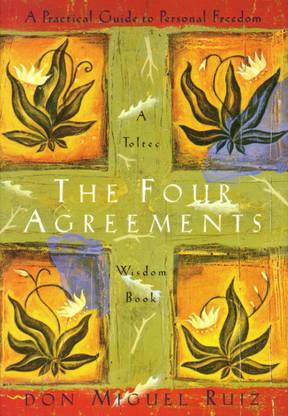
The Four Agreements

By Don Miguel Ruiz

What is this book?

If I need to give this a genre, you got me, it is a self-help book. But it is quite different, from all the books you read, that gives you this instant motivation and makes you think, you are unique and are here to perform massive tasks that none can perform. (Which is true)

The author states ‘four agreements’ as the title suggests.

So what is Agreement?

The talk you have with yourself or principles by which you live by. Principles can make concepts difficult to grasp, so I will deal with the first one.

“You can’t do that, you know”

“Hey, how can I forgive him for that?”

“Stop thinking too much”

Yeah all these talks, and how you talk with yourself depends on what agreements you have with yourself. You can have an agreement that dictates, ‘You can’t dance’ and also, ‘You can do anything if you give it a lot of time’.

These are the agreements, sort of things you have with yourself, you will live based on them, more than you think. So now, Ruiz proposes a plan. What if, you could change those agreements that can limit you or makes you take wrong decisions with respect to others. What if you can simply replace those agreements with agreements that definitely will guide you in a positive way.

How to overcome the old bad agreements you have with yourself?

As I said earlier, not just having the new agreements will help us. We need to get rid of those toxic relationship we have with ourselves.

You know how many times you abuse yourself? Sounds absurd? It is true. Think of times, when you thought it was all your fault. (I can hear you, but I just can’t believe you saying me, ‘It was all actually my fault, you know?’)

You know what, you can’t carry that guilt too far. It will drag you down. When someone stresses it’s your fault, you will likely believe them, than when they say, it was their fault. You will likely believe when those words when they come from people you love the most.

It’s fine, people most of the time, don’t utter the words they mean 100%. So, start searching for your own answers. Stop punishing yourself. Forgive yourself easily, it is no big deal. After all, you are always younger than tomorrow. Stop saying things to yourself, that you know, when you utter to others will break their heart. Don’t be harsh on yourself, you definitely don’t deserve that.

I know you are waiting to know what are those agreements

As I was when starting to read the book.

  1. Be Impeccable with Your word
  2. Don’t take anything personally
  3. Don’t make Assumptions
  4. Always do your Best

Aaah, this is what every self help book tells you, what’s the big deal?

Well, first off, I never saw a self-help book having contents this less. Telling ‘this is it, this is enough’ itself was such a great relief. (If you had known books with such less words in the contents page, go ahead comment it, I would love to read them too 🙂 )

Let me brief you on the first one. The word ‘impeccable’ is beautiful (or was it his explanation for it !?!?). It just means, ‘not capable of sinning’. I hear you, even I haven’t committed such ‘sins’, so hear me out. He says, sins are actions or beliefs, that affects you, the origin of those sins might be others or yourself. Don’t utter words you would clearly regret them later. It’s the most difficult agreement as he states. But the most important too.

When I was reading the next one, I felt I was constantly hit by a bullet. They were so true for me. I take everything personally so easily, that even sarcasm affects me (Yeah I know, it’s not the point of sarcasm). I was feeling so negative already, so I took in every cue that tells, you know what, you are trash. People most of the time, don’t even care about others’ actions, like about what dress you wear or how you laugh. The thing is, they are worried about themselves just like you, and they have no time to watch you and criticize you or have an opinion.

Have the courage. Yeah, don’t make assumptions. If in doubt, just ask questions, a lot of question if it needs. Just be brave enough to confront them and don’t end up making your own cloud of thoughts. You know, I love this, it reduces all the unnecessary stress you have. People will actually love to clarify than to know, you have got it all wrong. At the same time, don’t be annoying, just ask when you need to.

Now to this part, where you used to harass yourself. It’s just so simple. Give your best. Do all you can, the universe then catches up to you. The point is, even if the universe is a late bloomer, be happy and contented that you did all you can. I would like to add something here, even if you didn’t give your best. It’s fine. Forgive yourself and look for ways you can improvise. The most important thing of all this is, ‘don’t punish yourself, be a great friend to yourself”.

Do read the book, I can obviously, not state everything the author said or how he said. You will find very good moments when you read them. The book explains how we ended up like this, how to break those old agreements and how to form the new ones and live by them. To buy the book, click here

Rating: 4/5

I would love to know your thoughts if you had already read this book or you can come here anytime to tell about all that, once you read. I am all ears (well words, if comment section doesn’t support biomimicry)